 podcast
 video
video  photo
photo


Living Together with AI
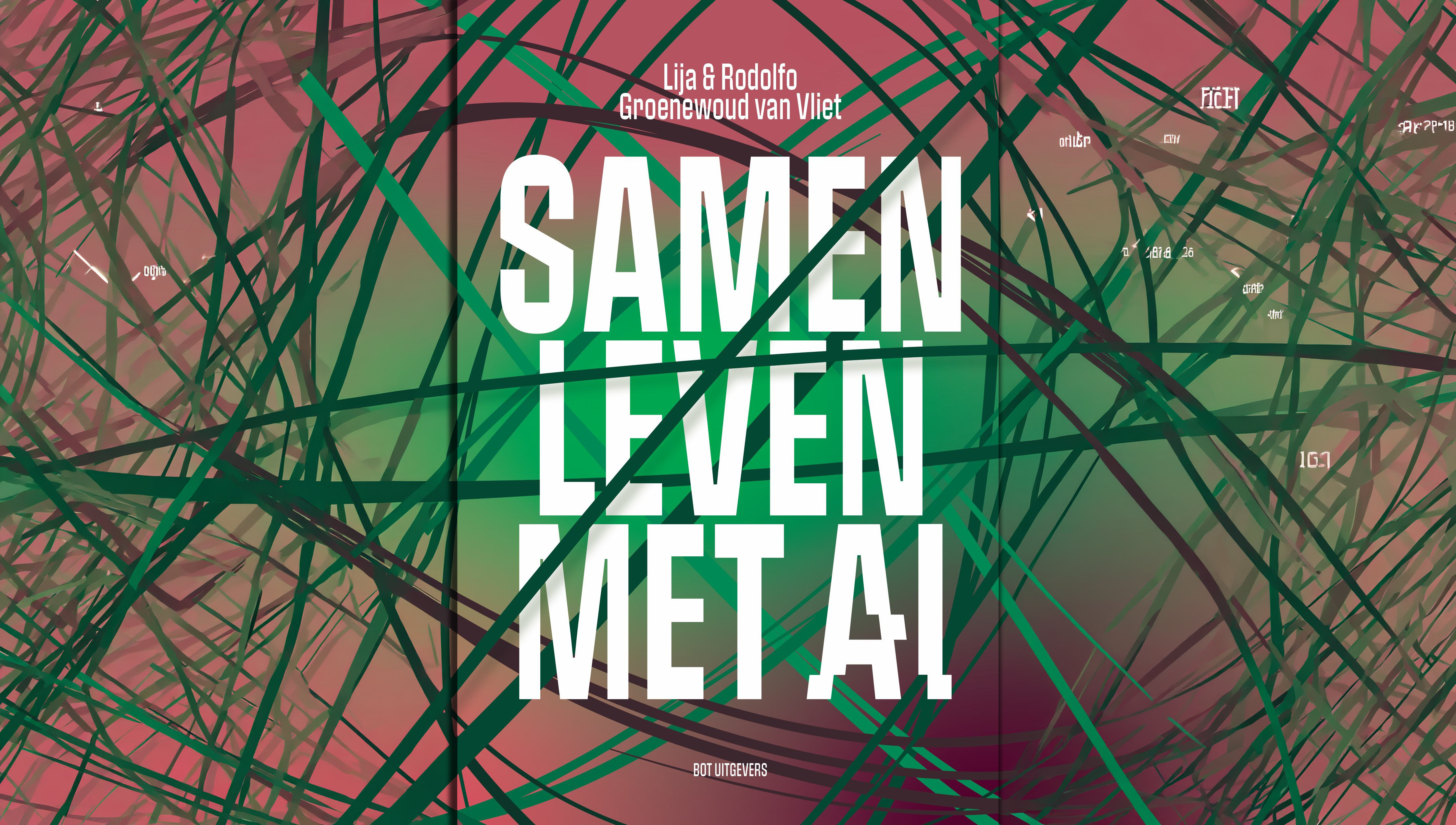
Samenleven met AI (Living with AI) is the latest book by Lija and Rodolfo Groenewoud van Vliet, published by Bot Uitgevers in Dutch language version in November of 2025. Regular readers will know Lija and Rodolfo from their 2021 participation in the Bassetti Foundation’s Art in Responsible Innovation series, in which they discussed motivations and ideas behind their In4Art organization, work from which underpins and expresses many of the arguments made in the book.
The authors describe Samenleven met AI as a voyage of discovery, a travel companion that enables the reader to learn about six species of AI that are currently transforming the world that we live in. Like any good companion in discovery, we learn not only about each individual species, but also about their habitats and resources that allow them to flourish. Through this analogy the authors demonstrate how different species of AI differ and have distinct “ecologies”, functions, strengths, and dangers just like animals in nature.
Six Species of AI
The six AI species — each with different capabilities, roles in society, benefits, and risks, are described metaphorically through expeditions: we meet and study the writing, seeing, forward-thinking, mimicking, self-learning, and symbiotic species. A football analogy at the start of each expedition is used to represent their operational practice, putting the mechanics of AI into context in an ironic but concrete manner, presenting flaws and possibilities (including limits) of each species, via its operating mechanism.
The writing species can help us to summarize and produce texts, but also create music and video from text or the other way round (think about Chat GPT and Luca Severino’s work as Steward.exe as examples). The seeing species is trained to recognize objects and situations through video and photos and can be used within medical imagery, as well as within industrial production settings and for facial recognition. The forward-thinking species uses previously learned rules to model further steps (the chess playing computer as an example). The mimicking species copy and imitate, can produce synthetic data for use in medical trails but also synthetic facts. The self-learning takes one step beyond, as it uses compressed data to discover patterns on its own, without the help of rules written by humans. Netflix ‘recreates’ the films we watch using this system. The Symbiotic species can be seen as an AI agent, it uses information from other AI systems and is able to react to its interpretation of this data (think about a synthetic podcast, with synthetic guests that discuss a topic).
The authors describe uses and concerns, present an array of implication for societies and offer an overview of possible applications, before offering an intricate analysis of the new world required for a global system based upon AI. Scarcity of minerals, questions about human rights of all forms, environmental concerns, the physical and digital infrastructure necessary, profit-making models in use, economic, legal and responsibility implications, as well as raising questions about the evolution of these species.
The book is well written, easy to follow (for someone who is still a Dutch learner), humorous, informative and critical without being one-sided. The authors mirror President Piero Bassetti’s question of power through their examples and descriptions (innovation creates power, but where or to whom will this power go?), which brings unfortunately a rather bleak response to a very pressing question. To offer an example, one of the everyday uses of AI brings real and concrete questions and implications for the Bassetti Foundation archive. If we consider the AI summaries that appear at the top of our results when we search using a large search machine, we see a movement in the ‘ownership’ of knowledge: a search for responsible innovation will present an AI generated overview that includes information taken from the Bassetti Foundation archives and other similar websites, offering the user a generic answer that may suffice their curiosity. The overview however will not contain links to the many websites that provided and created this knowledge. A website and archive that has taken 30 years to build and cost millions of Euros is summarized into 150 words without citation. Apart from the ethical questions, this practice may bring economic and institutional repercussions, as it may lead to fewer visits. In a related question, given the black box nature of AI, the design of the filter that produces these overviews may affect the information they contain, creating the possibility of bias and political alignment that will not be apparent to the user.
Philosophical Investigations
Reading this book reminds me of my time studying the philosophy of Ludwig Wittgenstein at Manchester University, especially his later work in Philosophical Investigations (first published in 1953). Wittgenstein’s reflections on meaning, language, and rule-following mirror the authors’ descriptions of how AI systems function and how they generate what appears to be (but is not) “understanding.” In particular, his ideas about the meaning of a word, family resemblance, and rules of the game illuminate both the power and the limitations of artificial intelligence.
Wittgenstein’s claimed that “the meaning of a word is its use in the language.” He rejected the idea that words have meaning because they correspond to abstract objects or inner mental images. Instead, meaning arises from how words are used within shared human practices. AI systems, especially large language models, operate in a way that strongly reflects this view. They do not possess inner mental representations in the human sense, nor do they attach words to fixed essences. Rather, they learn patterns of use across enormous datasets (of human language, videos, photos etc). A word’s “meaning” for an AI system consists in the statistical regularities governing how it appears in relation to other words and contexts. In this sense, AI embodies a use-based theory of meaning: it produces language by modeling how words function within linguistic practices, not by accessing some hidden essence behind them.
Wittgenstein introduced the concept of “family resemblance” to challenge the idea that all members of a category share a single defining feature. He used the example of “games,” arguing that there is no one property common to all games; instead, they are connected by overlapping similarities—like members of a family who resemble each other in different ways. AI classification systems mirror this insight. When an AI identifies something as a “chair” or a “game,” it does not rely on a strict definition with necessary and sufficient conditions. Instead, it detects clusters of overlapping features learned from data. Categories are formed through patterns of resemblance across many examples, not through rigid definitions. This reflects Wittgenstein’s point that our concepts often function through networks of similarity rather than sharp boundaries.
Finally, Wittgenstein’s discussion of “rules” and “language-games” is also relevant to the book. He argued that following a rule is not a matter of privately interpreting it but of participating in a shared practice governed by public criteria. Meaning emerges within “language-games,” structured forms of life in which rules guide how expressions are used. AI systems can be seen as participating in human language-games by learning and reproducing the rules embedded in linguistic data. However, they do so without genuine participation in a “form of life.” They follow rules in a purely formal, computational sense. This raises a philosophical question central to Wittgenstein: does rule-following require human forms of life, or can mechanical pattern replication suffice? AI seems to follow rules, yet it does so without the social and embodied context that Wittgenstein considered essential to meaningful language use.
Artificial intelligence reflects key elements of Wittgenstein’s later philosophy. Its operation supports a use-based account of meaning, demonstrates the practical reality of family resemblance categories, and highlights complex issues about rule-following and language-games. At the same time, AI also sharpens Wittgenstein’s concerns by forcing us to ask whether genuine understanding requires participation in human forms of life—or whether mastery of patterns of use is enough.