 podcast
 video
video  foto
foto


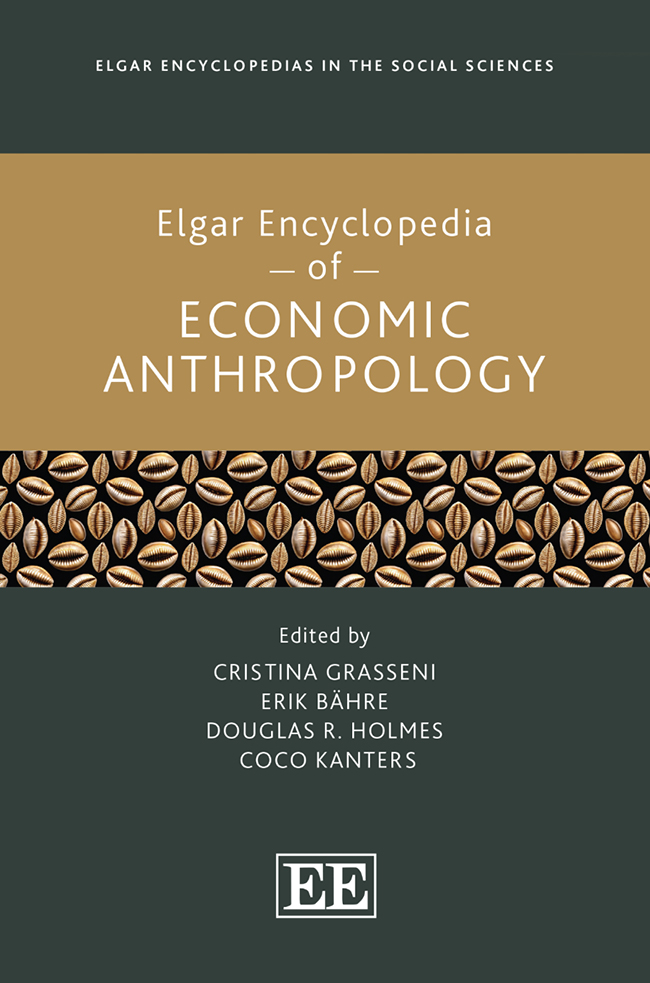
The Elgar Encyclopedia of Economic Anthropology is edited by long standing Bassetti Foundation collaborator Cristina Grasseni, alongside Erik Bähre, Douglas R Holmes and Coco Kanters.
In their introduction, the editors describe the porous and changing boundaries of the discipline of economic anthropology, alongside recent developments in the landscape that have led to a host of new areas for debate. The entries in this encyclopedia reflect this movement, mapping lines of innovative development in research by including the topics of inquiry that the contributors are themselves following today, such as ‘new craft’ and financialisation, neoliberal retrenchment and digital design. Following this logic, the encyclopedia is divided into topical sections rather than arguments placed in alphabetical order, each section filled with ethnographically informed ‘curiosities’ that are designed to provoke and unsettle the reader with conventional and unconventional views upon the economic life that surrounds us all, and which we all participate in.
In Part 1: Natural Resources, the reader learns about multi species approaches to valuing nature in game farms in South Africa, value chains in gold mining in Ghana, value making in post war landscapes in Belgium and the financialization of water in Europe. Global issues addressed include the extraction and control of energy related resources, the role of insurance and its relationship to morality in times of crisis, the complexity of thinking about climate finance and a call for the inclusion of decision-making processes in the analysis of natural resource use.
Part 2 explores corporations and emerging markets, their institutional intrigues, conceptual foundations in law, and human relations. Contradictions in large scale service and consumer cooperative practices in Northern Italy raise questions of the ‘moral economy’, as does the construction of spheres of economic activity which (also) enable economic exploitation. Spiritual and ethical agendas in business and finance in both Asia and Africa raise a host of related questions, whereas entries addressing alternative currency design (with the aim of money for the greater good), the critical role of the insurance industry in the contemporary capitalist economy, and users’ experience of video games as cultural objects offer an entirely different viewpoint.
In Part 3, care emerges as both a binding and ambivalent concept across several states in Africa and Europe and within the US and china, as it brings both hope and exhaustion. Informal self help groups, food banks and cooperatives, the solidarity economy and alternative food networks are all brought into focus, with the themes of webs of relations and future-making that entangle individuals, communities and more-than-human and non-human actors coming to the fore. These contributions offer further analysis and colour to the discussion of cooperative practices outlined in part 2.
Part 4 introduces scale and global circulation, focusing on the global hierarchy of value, commodity certification and the roots of modern container capitalism (in expansionalism, colonialism and imperialism) and how they is reflected in present day practices. A series of three entries focused on envisaging the future highlights both the importance of entrepreneurship and of craft, and includes an entry of Responsible (Research and) Innovation (authored by the Bassetti Foundation’s Jonathan Hankins) that Cristina Grasseni builds upon with her entry about making and crafting futures.
Economies of statecraft are the focus of Part 5, the reader introduced to a series of arguments about how economies are shaped by their institutions, from Sweden, the UK, Tanzania, Croatia, Slovakia, Austria and Eastern Europe more broadly. Central bankers, housing markets, taxation and wider fiscal policy, access to state resources and ideologies about poverty in international development and household solidarity all take centre stage, as does the recurrent theme of care which also runs throughout these entries.
A critique of gendered economic relations animates Part 6, with topics addressed such as the circulation of digital money, divorce (both examples from Kenya), multi level marketing in the USA, family business and the insurance markets in Italy and domestic work in Switzerland, all supported by entries that reflect upon anthropological fieldwork in Greece and the UK. Issues such as gender in relation to care and kinship, the roles and limitations of kinship networks, societal values and moral dilemmas, economic expectations, sexuality, paid and unpaid labour, affective kinship and dignity are all discussed and unpacked.
The Encyclopedia’s penultimate section focuses on infrastructure, technology and digitization, with entries that highlight practices in the Port of Rotterdam, those of private equity investors, within digital money domains, on film sets, in land occupations and finally within payment companies and consultancies and their users.
The Encyclopedia closes with an investigation into skill, labour and precarity, in which entries explore diverse performances and notions of skill against the backdrop of local and global economies. Ethnographies support investigation into various forms of precarious labour in Brazil, Poland, Mongolia, Trinidad, China and the USA. Creativity, resistance and thrift are all on show from street children in Sao Paolo and those living in the USA ‘rust belt’, through technical tinkering, entrepreneurship, poetry and craft learning but also in global garment industry.
This encyclopedia offers the reader a broad spectrum of short, concise ethnography based insights into the workings of the modern capitalist world. Each entry is typically four pages long, does not require previous knowledge or specific understanding of anthropological language and can be read independently or as part of a series. Many of the issues addressed overlap, and several of the entries could be placed in different parts of the collection, making for a fascinating read.
The Elgar Encyclopedia of Economic Anthropology is available from Edward Elgar Publishing via the link above, in both hardback and eBook format.