 podcast
 video
 foto


On 6th and 7th October, 2027, the Place-based Circular Society Innovations project headed by Manchester Metropolitan University held its Year 2 meeting in Utrecht, with Bassetti Foundation Foreign Correspondent Jonathan Hankins attending in his role as Advisory Board member. In this post Research Associate Sarah Walker and Jonathan offer their thoughts.
The aim of the Place-based Circular Society Innovations project is to investigate circular society innovations for place-based equitable, inclusive and environmentally sustainable living, with case studies in Greater Manchester, London, Utrecht, Turku and Chicago. As regular readers will know, Utrecht School of Applied Sciences is a partner in the project and organized this two-day meeting to share their experiences and sites with more than 40 stakeholders from across the project.
The event opened in Dotslash, the largest scale-up and start-up hub in the Netherlands, with a talk from Tim Savenije (Senior Advisor in Circular Economy and Entrepreneurship to Utrecht City Council), who shared local context and current and future plans within the city. Then came a ‘serious’ game of snakes and ladders to learn about what it takes to support mobility in line with circularity and societal needs. Designed and led by Sarah Walker of Manchester Metropolitan University, each team was given five things a neighbourhood needs, and half an hour to work out which matter most.
A Green Spaces for People, Planet & Community workshop followed (designed by Georgina Adebisi and led by Prof Weslynne Ashton of Illinois Tech), in which teams created green spaces for different community contexts using environmental, social, and circular interventions, with unexpected scenarios introduced during proceedings.
The day continued with a visit to Steck, a garden centre that has been transformed into a green oasis where local businesses work together to green Utrecht, not only with plants but also ideas and practices. Steck Marketing Manager Arnout Baas led us around the community gardens area, passing the beehives and into the bamboo forest. We then split off into groups to learn more about the different activities taking place onsite, including growing and harvesting sessions with community groups, a school lunchbox scheme, mushroom growing and permaculture. The evening closed with dinner on the canal-side in the centre of the bustling fortified city of Utrecht.
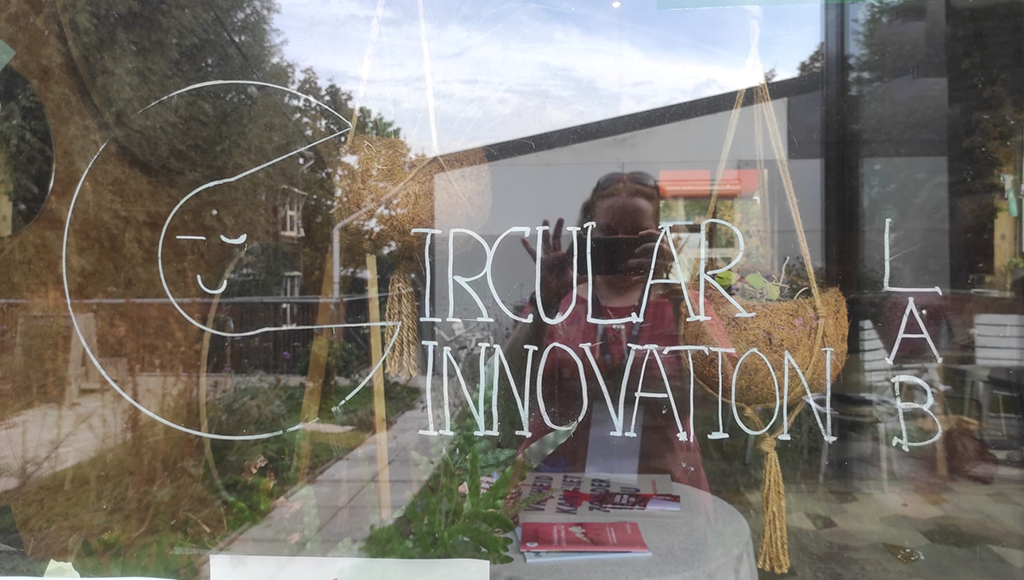
Day 2 was held at the Hof van Cartesius, a complex built from reclaimed materials that opened in 2017 and now hosts 8 pavilions that work as testing grounds for circular and green business approaches.
The day opened with the Advisory Board meeting, during which project plans for the coming year were presented and discussed. This was followed by an extremely stimulating Change-makers and Change making round table with Erika Allen, Founder and CEO of Urban Growers Collective (in Chicago), Jonathan Pereira, Executive Director of Plant Chicago, Wayne Hubbard, Former CEO of ReLondon and Charlotte Ernst, Founder of Het Hof van Cartesius. Each panellist opened by reflecting on their own life course: what brought them to their current work and what continues to motivate them. Drawing on Roth and Saunders’ (2025) characterisation of change-makers as boundary-crossers, bridge-builders and coalition builders, the conversation turned to collaboration, including who they work with, how, and what they have learned from partnerships that have thrived or struggled. Finally, linking to our ongoing work on prefiguration (living the future we wish to see today), panellists shared their visions of circular society futures, what it will take to get there, how they nurture change-makers in their communities and in policy, and the challenges they foresee along the way.
The afternoon comprised a circular society hubs under pressure survival game (designed and led by Suzanne van Osch of Utrecht University of Applied Sciences), in which the players built a CSI ecosystem by mapping its actors, connections and resources, which then face a series of opportunities and challenges that require responses in order to keep the system operational.
A Viable Futures for a Circular Society workshop (designed and led by Eerika Heinonen of Turku University of Applied Sciences) then transported participants to 2046, where they co-created practical visions for circular society innovations, identifying emerging pockets of future already taking shape, and mapping the actions needed to turn those possibilities into reality.
The event was fast-paced, varied and stimulating. Participants singled out the site visits to circular society initiatives across Utrecht as a highlight, offering “evidence of what is possible”, alongside the serious games, which opened up new ways of sharing experience across partners. Several were struck by how central the social dimension is to circularity, by the scale grassroots organizations can reach, and by the common ground shared by very different projects. Feedback also pointed to familiar challenges: funding pressures that pull organizations away from their core goals, making sure recommendations are taken forward once funding ends, and bridging the gap in language between community organizations and local authorities so that councils, too, see themselves as change-makers.
A number of people asked for more time to reflect and digest, a sign of how much there was to take in. As one participant put it, the meeting gave them “space to breathe, learn, enjoy a change of scene and meet others with hope”, and for some, collaborations have already grown wider than the project itself.
Congratulations and thanks to all those involved.
Readers who would like to follow the project can join the project’s Knowledge Action Network and the Bassetti Foundation newsletter.