 podcast
 video
video  photo
photo


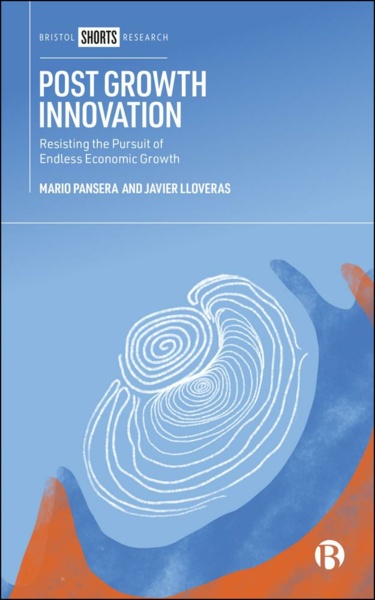
Authored by Mario Pansera (whose work regular readers will know) and Javier Lloveras, Co Director of the Post Growth Innovation Lab, Post Growth Innovation: Resisting the Pursuit of Endless Economic Growth is an open access Research Short published by Bristol University Press.
This short, easy to read book is based upon research that was funded by a Starting European Research Council grant ‘PROSPERA: Prospering without growth: Science, Technology and Innovation in a post-growth era’, The Ramón y Cajal programme and an EU Horizon MSCA Individual Fellowship.
The direction of technological innovation is not predetermined but is a matter of political and societal choice.
Exploring how the concept of technological innovation has become a central pillar in what they describe as the ‘religion of economic growth’, the authors argue that technical innovation is not neutral or inevitable but a social process shaped by specific values and goals (which are often set by powerful elites who prioritize their own interests) and which over time become so deeply embedded in society that they are no longer questioned but are treated as common sense.
Bridging Science and Technology Studies (STS) and post growth perspectives, the book challenges the prevailing assumption in economics and policy making that innovation and growth are (and must be) linked, while also critiquing several existing post growth narratives which often adopt a reductive low-tech stance that fails to capture the complexity and diversity of innovation.
Responsible Research and Innovation (RRI): responsible toward what kind of society, and toward which ends should innovation be directed?
Developing an argument made by Langdon Winner (which we often cite in the Foundation) that artifacts have politics, the authors show how innovations constitute systems of interconnected technologies, social structures, and power relations. The implications of this are wide ranging, as any movement towards post growth planning would require the development of a broad political and technological programme capable of reversing and dismantling the growth-driven mechanisms embedded in these systems.
Innovation must be critically examined and shaped to serve goals beyond economic growth namely, social justice, ecological sustainability, and democratic forms of participation.
The book narrates changes in the meaning of the concept of innovation (particularly the post Second World War movement towards economic growth as its goal), the relationships between accepted models of innovation and colonialism and its links to ecoside, epistemicide and genocide.
It critiques the idea that technology development is inevitable (technological determinism), that more innovations is always better (productivism), and mirroring a discussion that is very much in the news today, that no matter how complex and pervasive our technologies become, we will always be in control (the illusion of control).
The right to repair, upkeep and maintenance are presented as vital, democratized acts of care.
The authors discuss what infrastructure, organizations and institutions for post growth could look like, offering several examples of ideological movements (such as the appropriate technology movement and the concept of technological disobedience) alongside several practical approaches (such as those followed by iFixit and The Social Technology Network). They describe how post growth organizations focus on innovation that is normatively driven, predominantly targeting social and ecological concerns. Infrastructures present formidable challenges as they are designed for growth and have to be completely imagined, while the lack of democracy within many aspects of our lives, including in our workplaces, is reflected within the organizations that are building systems that embed their roles as problem solvers and exclude the public from decision-making or influence.
The authors call for a radical restructuring of scientific, financial, and political institutions, organizational forms and benchmarks for measurement, for further research and political mobilization. They offer the example of Ivan Illich, who developed structured imaginaries of socially controlled technological development. His vision of technology placed power in the hands of communities rather than corporations, emphasizing the importance of democratic governance over innovation and production.
This concise and thought-provoking publication can be purchased through the link above or downloaded for free here.